Why Insurance Products Belong in Your Retirement Plan
Dominik Yates · · 10 min read

Most retirement plans are built entirely around investments — a mix of equities, bonds, and tax-advantaged accounts designed to accumulate enough wealth to fund a 20- or 30-year withdrawal window. That framework works well during the accumulation phase. Where it tends to unravel is in distribution, when market volatility, longevity risk, and sequence-of-returns risk converge at the worst possible time. Research-backed analysis of two specific insurance products — permanent life insurance (PLI) and deferred income annuities with increasing income potential (DIA with IIP) — suggests that integrating either into a financial plan can produce meaningfully better retirement income and legacy outcomes than an investment-only strategy. The case is worth examining closely, because the numbers are more consistent than many advisors expect.
The Scale of the Problem These Products Address
Americans have accumulated significant retirement wealth. According to the Investment Company Institute's September 2026 release, total U.S. retirement assets reached $51.2 trillion as of June 30, 2026, up 7.9% from the first quarter. IRAs alone held $19.9 trillion — the largest single retirement-market category. By raw accumulation standards, those figures represent genuine progress.
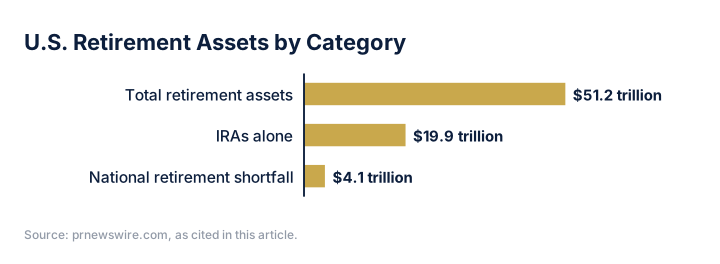
Despite trillions in accumulated retirement assets, a projected national shortfall highlights the gap insurance products aim to address.
The challenge is structural. The EBRI projects that about 43% of U.S. households will run short of money in retirement, representing a national shortfall near $4.1 trillion. The gap tends to widen precisely as retirement approaches: workers in their final decade face both a compressed savings window and the highest exposure to sequence-of-returns risk. Meanwhile, an April 2026 EBRI/Greenwald Retirement Confidence Survey found that 84% of workers in a workplace plan are interested in a guaranteed monthly income product — yet only 36% of retirees actually own one. The demand is there. The coordination rarely is.
This is the specific gap insurance products are positioned to address — not by replacing investments, but by working alongside them to solve for income reliability and legacy preservation simultaneously.
What the Research Actually Shows
Our team reviewed quantitative analysis examining five strategies across multiple case studies — 25-, 35-, and 45-year-old couples at different wealth levels — using Monte Carlo simulations across 1,000 scenarios. Each scenario tested different mixes of interest rates, inflation, equity returns, and bond returns across the planning horizon. Two outcome metrics were tracked: after-tax retirement income at 90% probability of success, and legacy value at the end of the time horizon.
The findings were consistent across age cohorts. For a 25-year-old couple starting with $45,000 in total initial wealth and saving 20% of a $60,000 household salary, an investment-only strategy produced projected retirement income of approximately $61,250 (after tax, 90% probability). Allocating 30% of annual savings toward PLI premiums raised that figure to $62,500 — a 2% improvement — while increasing projected legacy by 13.4%. The PLI + DIA with IIP combination at a 20% / 20% allocation produced a 4.6% retirement income improvement and a 12.1% legacy improvement compared to the investment-only baseline.
Term life combined with investments, by contrast, reduced retirement income by 2% to 4.6% across tested allocations, with comparable legacy erosion. Term coverage provides an affordable death benefit for a defined period, which is a legitimate use case — but it does not function as a wealth accumulation or volatility management tool, and treating it as one carries a measurable cost in long-run outcomes.
How PLI Fits Into the Architecture
Permanent life insurance in this context does two things that investments alone cannot do. First, it provides guaranteed cash value growth combined with a death benefit — a combination that tends to outperform fixed income in long-run scenarios, partly because mutual life insurance companies, as institutional investors, access asset classes unavailable to individual investors. Second, the cash value can be accessed via policy loans or surrenders during periods of market volatility, allowing an investor to avoid selling depressed portfolio assets to fund retirement income. This is the volatility buffer function: PLI cash value becomes the source of income when markets fall, while investments are left to recover.

Integrating insurance products into a retirement plan addresses income reliability and legacy preservation simultaneously.
The analysis found that allocations of 10% to 30% of annual savings toward PLI are generally supportable across income and age profiles. Beyond 30%, the allocation redirects too much capital away from equities, which reduces the overall income potential. The allocation that maximizes legacy tends to be higher — investors primarily focused on wealth transfer may find PLI allocations above 30% defensible — but the trade-off in income is real and should be modeled explicitly.
The Role of Deferred Income Annuities with Increasing Income Potential
DIA with IIP products function differently from PLI. They are funded later — the analysis modeled purchase at age 55 using a portion of accumulated wealth — and they deliver a stream of guaranteed lifetime income in retirement, typically with no tangible account balance or death benefit attached. The "increasing income potential" feature rewards those who stay invested: dividends and bonuses build over time, increasing the eventual income payout for investors who reach retirement without surrendering the product early.

Deferred income annuities reward long-term commitment by building increasing income potential over time.
The DIA with IIP strategies showed the strongest retirement income outcomes across all tested allocations. For the 25-year-old couple, allocating 30% of projected wealth at age 55 toward a DIA with IIP produced projected retirement income of $66,250 — an 8.2% improvement over the investment-only baseline — while still delivering legacy values above the investment-only level. This result holds because DIAs with IIP outperform fixed income due to mortality credits: when annuitants die earlier than expected, their forfeited principal effectively subsidizes the income of those who live longer. The mortality credit is a form of return that is structurally unavailable in a traditional bond portfolio.
The trade-off is transparency: DIA with IIP products have no account balance to show on a statement, and income does not pass to heirs upon death. Investors with strong legacy motivations may find PLI more appropriate; investors primarily concerned with income sufficiency may find DIAs with IIP the better tool. Many benefit from holding both.
Integrated Strategies Outperform in Both Dimensions
When PLI and DIA with IIP are combined with investments — rather than treated as either/or replacements for bonds — the results reinforce each other. For the 35-year-old couple modeled, a combined PLI + DIA with IIP + investments strategy produced meaningfully higher projected retirement income and legacy compared to an investment-only approach. The same integrated strategy for the 45-year-old couple showed that the PLI and DIA with IIP allocations functioned as a substitute for bonds — reducing fixed-income drag on the portfolio without sacrificing the downside protection that bonds traditionally provide.

Combining permanent life insurance and deferred income annuities with investments can improve both income and legacy outcomes.
The practical finding is not that insurance products replace investments — it is that they can do specific jobs more efficiently than bonds, particularly around guaranteed income and volatility management, when sized appropriately and coordinated within a broader plan.
Critically, integrated strategies delivered better outcomes whether the analysis anchored on a 90% or 75% probability of success, and across all three age cohorts. The pattern was robust, not scenario-dependent.
Sizing and Sequencing Matter
Effective integration requires precision. A few observations from the research that bear on how these allocations should be framed:
- Start PLI early. The case for PLI is strongest when premiums are funded over decades. For younger savers, redirecting 10%–20% of annual contributions toward PLI costs relatively little in accumulated wealth while building a meaningful volatility buffer and death benefit well before retirement. Waiting until your 50s to initiate coverage is feasible, but the compounding benefit is substantially diminished.
- Time DIA with IIP funding to mid-career wealth accumulation. The analysis modeled DIA with IIP purchase at age 55, using a share of accumulated portfolio wealth. That timing allows the increasing income potential feature to compound meaningfully before income begins, and aligns the guaranteed income layer with the period when sequence risk is highest — the decade straddling retirement.
- Treat both products as fixed-income alternatives, not equity alternatives. The asset allocation logic here is straightforward: PLI and DIA with IIP occupy the capital-preservation role that bonds traditionally fill. For investors with an aggressive equity tilt, substituting a portion of bond allocation for PLI or DIA with IIP may produce better income and legacy outcomes without increasing equity concentration.
Why This Is Becoming More Relevant in 2026
The regulatory and market environment is moving toward greater acceptance of insurance-based income solutions within retirement plans. In March 2026, the Department of Labor introduced a proposed rule designed to establish a process-based framework for incorporating lifetime income solutions into defined contribution plans. That proposal, still under review, reflects a broader acknowledgment that investment-only plan designs leave a structural income gap that products like deferred annuities are designed to fill.
At the same time, an April 2026 EBRI/Greenwald survey found that two-thirds of workers are interested in a bridge annuity to delay Social Security to age 70 — a strategy that pairs well with DIA with IIP products by using guaranteed income to bridge the gap between early retirement and maximum Social Security claiming. That coordination across guaranteed income sources is exactly the kind of architecture that tends to produce durable retirement outcomes.
Common Questions
Does adding insurance products to a retirement plan reduce overall investment returns?
Not necessarily, and in many modeled scenarios, the answer is the opposite. When PLI and DIA with IIP allocations replace a portion of fixed income rather than equities, the equity allocation stays intact while the bond-like capital preservation function is performed more efficiently. The research examined here found that integrated strategies produced higher after-tax retirement income and higher legacy values than investment-only strategies across 25-, 35-, and 45-year-old couples — including in higher risk-tolerance scenarios anchored at 75% probability of success.
What is the difference between term life and permanent life insurance in a retirement context?
Term life provides a death benefit for a defined period and typically costs less than permanent coverage — a reasonable choice when the primary goal is pure protection during the working years. Permanent life insurance builds guaranteed cash value over time, which can be accessed via loans or surrenders during periods of market volatility, functioning as a volatility buffer. The analysis found that PLI + investment strategies produced better retirement income and legacy outcomes than term life + investment strategies across all tested allocations, with term life actually reducing projected retirement income relative to an investment-only baseline at higher allocation levels.
How should someone think about how much of their savings to allocate to these products?
The research suggests that allocations of 10%–30% of annual savings toward PLI and 10%–30% of accumulated wealth toward a DIA with IIP (typically modeled at age 55) are generally supportable across income and age profiles. Allocations above 30% may still be appropriate for investors primarily focused on maximizing legacy, though the trade-off in retirement income becomes more pronounced at higher levels. The right sizing depends heavily on individual income needs, existing guaranteed income sources like Social Security and pensions, legacy objectives, and overall asset allocation — factors that require a comprehensive plan rather than a rule of thumb.
Sources
- Total US retirement assets reached $51.2 trillion as of June 30, 2026, per ICI
- EBRI projects 43% of US households will run short in retirement, national shortfall near $4.1 trillion
- 84% of workers in a workplace plan are interested in a guaranteed monthly income product; only 36% of retirees own one — EBRI/Greenwald 2026 Retirement Confidence Survey
- In March 2026, the Department of Labor introduced a proposed rule for incorporating lifetime income solutions into DC plans
- EY study: five strategies, three age cohorts (25/35/45), 1,000-scenario Monte Carlo