Why Accumulation Phase Decisions Shape Your Retirement Tax Bill
Jermaine Carter · · 8 min read
Most retirement planning conversations begin at the wrong end. They start with how much to save — the contribution limit, the employer match, the account balance milestone — and rarely pause to ask: what does this pile of money look like when it gets taxed on the way out? That ordering problem, more than investment returns, is what leaves many high earners with fewer choices, more risk, and a larger tax burden in retirement than they ever anticipated.
The accumulation years are when account type, asset location, and income diversification decisions get locked in. Getting those decisions right requires planning with the end in mind — a principle we call principle-first retirement planning. Every dollar directed into a pre-tax 401(k) today creates a future obligation to the IRS. Managing that obligation effectively, while you still have options, is the work that retirement income planning depends on.
The 2026 Contribution Environment: New Limits, New Rules
The IRS raised contribution limits again for 2026. The employee deferral limit for 401(k), 403(b), and most 457(b) plans rose to $24,500, up from $23,500 in 2025. IRA contribution limits increased to $7,500, up from $7,000 the prior year. For savers in their early 60s, the SECURE 2.0 "super" catch-up brings the 401(k) ceiling even higher: participants ages 60 through 63 may contribute up to $11,250 in catch-up contributions instead of the standard $8,000.
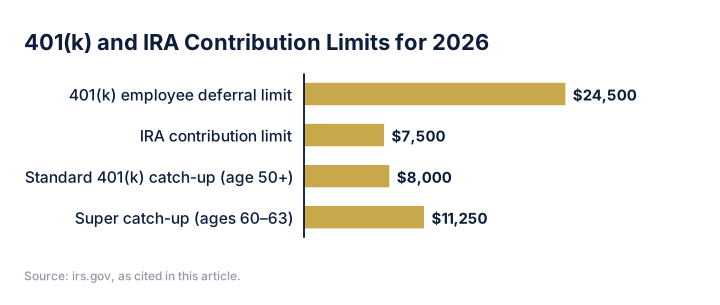
The 2026 contribution limits show how much savers at different ages can direct into tax-advantaged accounts.
These expanded limits are genuinely useful. But higher limits without a strategic framework can accelerate the wrong problem. Directing every additional dollar into traditional pre-tax accounts maximizes the current deduction and, simultaneously, maximizes the future taxable account balance. That calculation needs to run both ways before you decide where the extra contribution goes.
A significant rule change that took effect January 1, 2026 reinforces this point. Under SECURE 2.0 Section 603, employees age 50 or older whose prior-year FICA wages from their employer exceeded $150,000 are now required to make their catch-up contributions on a Roth — after-tax — basis. The IRS delayed implementation of this rule twice before it finally took effect this year. For high-earning professionals age 50 and above, this means the pre-tax catch-up option has closed, and the Roth treatment is mandatory regardless of preference.
There is a planning silver lining in that constraint. Roth contributions made today accumulate without future income-tax liability. For someone still in a high bracket during accumulation, paying tax now on the catch-up amount could reduce the eventual tax drag on a portion of the portfolio — though the right answer depends on current vs. projected tax rates and is worth modeling carefully with an advisor.
The Tax Trap Hiding Inside a Well-Funded Pre-Tax Account
The appeal of pre-tax deferral is real and rational: reduce taxable income now, defer the tax, let the balance grow. The problem emerges at the other end, when every withdrawal carries ordinary income-tax treatment and required minimum distributions (RMDs) begin arriving whether or not you need the cash.
Consider the cascade of effects a large pre-tax account creates. An additional IRA withdrawal raises provisional income, which determines how much of Social Security becomes taxable. Even a modest 401(k) withdrawal could push you from 50% to 85% of your benefits being taxable — a threshold that arrives quietly and is painful to reverse. Meanwhile, capital gains that might otherwise face a 0% rate in a lower-income year can be taxed at 15% or higher in a year where required distributions have already pushed your income up.
Tax concerns are not abstract. According to the Allianz Center for the Future of Retirement's Q1 2026 Quarterly Market Perceptions Study, 70% of U.S. respondents said they were concerned about how taxes would affect their income in retirement. Two in three worried that taxes would significantly reduce the amount they could spend. Yet the Allianz 2026 Annual Retirement Study found that the majority of Americans — 61% — are not sure how their taxes in retirement will compare to their current tax situation. That combination — broad concern with limited clarity — reflects what happens when accumulation runs ahead of distribution planning.
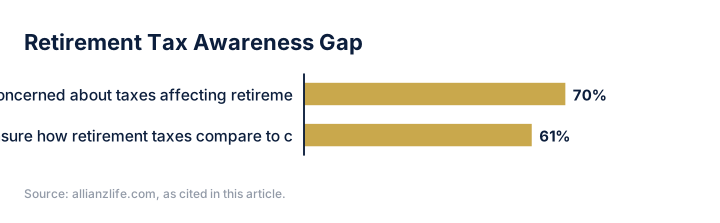
Survey data illustrates how widespread tax concern in retirement contrasts with limited clarity about what to expect.
Retirement Savings Momentum and the Planning Gap
The tax uncertainty problem compounds a broader savings challenge. Goldman Sachs Asset Management's Retirement Survey and Insights Report 2026, conducted with 5,106 working and retired Americans in July 2026, found that retirement savings momentum is stalling across every generation. Among Gen X, the share of respondents saying their savings were on track fell from 58% to 49%. Among Millennials, it dropped from 74% to 61%.
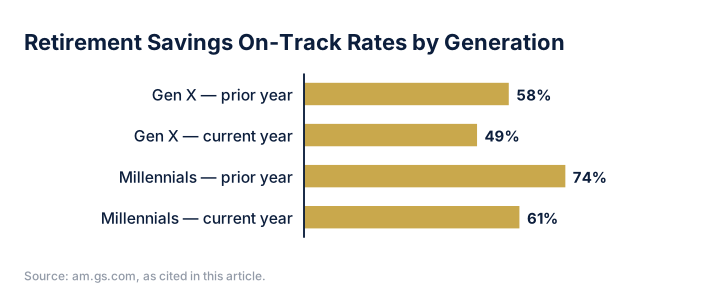
Goldman Sachs survey results show the share of savers calling themselves on track has declined across generations.
When savers are already running behind, an inefficient tax structure in retirement can shrink spending power further without any market-related cause. Tax drag compounds over time. Research published earlier in 2026 illustrated the stakes clearly: over 25 years, a 1.2 percentage-point difference in annual tax drag on a $10 million portfolio can produce an $11.1 million difference in ending wealth — not through any change in market exposure, but simply through tax efficiency.
For the high-earning professionals, business owners, and pre-retirees we work with, the numbers rarely involve $10 million portfolios — but the principle scales. At any balance level, an unconsidered allocation between pre-tax, Roth, and taxable accounts during accumulation creates costs in retirement that are difficult to unwind once RMDs have begun and tax brackets are set.
What Principle-First Planning Actually Changes
The principle-first approach asks the distribution question during accumulation, not after it. That means building a diversified tax structure across account types — traditional pre-tax, Roth, and taxable — so that future withdrawals can be sequenced to manage ordinary income, capital gains recognition, and Social Security taxation in the same year rather than in isolation.

Time spent in the accumulation phase sets the tax conditions a retiree will face for decades.
It means reviewing Roth conversion opportunities in years when income dips: a business transition year, a gap year before Social Security begins, or a year when equity compensation vesting is lighter. It means examining whether the mandatory Roth catch-up rule creates an opportunity to accelerate post-tax accumulation rather than treating it as a bureaucratic obstacle. And it means building a withdrawal strategy that considers the full income stack — pension, Social Security, RMDs, investment income — rather than managing each source separately.
The accumulation decisions made today determine the tax options available in retirement. Plan for the outcome you want, not just the balance you want to reach.
None of this is about chasing tax-free status for its own sake. Pre-tax accounts remain valuable tools. The goal is optionality: a portfolio structured so that future income can be drawn from the account type that produces the lowest tax cost given that year's circumstances. That flexibility is built in accumulation. It cannot be fully reconstructed once RMDs begin at age 73.
Common questions
What are the 401(k) and IRA contribution limits for 2026?
For 2026, the IRS set the 401(k) employee deferral limit at $24,500. The IRA contribution limit rose to $7,500. Workers age 50 and over may contribute an additional $8,000 in standard 401(k) catch-up contributions, while participants ages 60 through 63 are eligible for an enhanced "super" catch-up of $11,250 instead of the standard amount. The combined employer-plus-employee defined contribution plan limit for 2026 is $72,000, per IRS Notice 2025-67.
What is the new SECURE 2.0 Roth catch-up rule and who does it affect in 2026?
Beginning January 1, 2026, employees age 50 or older whose prior-year FICA wages from their plan-sponsoring employer exceeded $150,000 must make their catch-up contributions on a Roth (after-tax) basis. The rule — originally scheduled for 2024 but delayed twice by the IRS — eliminates the pre-tax option for catch-up deferrals for those above the income threshold. The $150,000 figure is indexed for inflation, and for 2026 it is based on 2025 wages.
Why does account type during accumulation affect taxes in retirement?
Traditional pre-tax accounts — 401(k)s, IRAs — produce ordinary income upon withdrawal. That income stacks with Social Security, pensions, and other sources, potentially pushing a larger share of benefits into a taxable range and compressing access to lower capital gains rates. A portfolio with no Roth or taxable component gives the retiree little flexibility to manage income in a given year. Building diversified account types during the working years creates options to draw income strategically, reducing the tax cost of spending without reducing the spending itself.
Sources
- IRS Notice 2025-67 sets the 2026 defined contribution plan limit at $72,000 and IRA deductible limit at $7,500.
- IRS confirms the 2026 super catch-up for ages 60–63 is $11,250.
- Starting in 2026, higher earners who made more than $150,000 in prior-year wages must make catch-up contributions on a Roth basis.
- Allianz Q1 2026 study: 70% of U.S. respondents were concerned about how taxes would affect their income in retirement.
- Allianz 2026 Annual Retirement Study: 61% of Americans are not sure how their taxes in retirement will compare to their current tax situation.
- Goldman Sachs 2026 Retirement Survey (5,106 respondents, July 2026): Gen X on-track share fell from 58% to 49%, Millennials from 74% to 61%.
- A 1.2 percentage-point difference in annual tax drag on a $10 million portfolio can produce an $11.1 million difference in ending wealth over 25 years.
- Even a modest 401(k) withdrawal could push you from 50% to 85% of Social Security benefits being taxable.
- IRS raised the 401(k) employee deferral limit to $24,500 for 2026, up from $23,500.