The 2027 Social Security COLA: What Women 50+ Need to Know
Selena Teasley · · 13 min read
On October 14, 2026, the Social Security Administration announced a 3.6% cost-of-living adjustment for 2027 — the largest increase since 2023. For the average retiree, that translates to roughly $75 more per month, with the average all-retired-worker benefit rising to approximately $2,170 starting in January 2027. That headline number matters. What matters just as much is understanding what it does — and what it leaves unresolved — particularly for women in or approaching retirement, where Social Security, taxes, Medicare, and longevity interact in ways that can quietly erode a plan built on each piece separately.
Women and Social Security: A Gap That Compounds
The 3.6% COLA applies uniformly across all recipients, but the base benefit it adjusts is far from uniform. As of December 2025, the average monthly Social Security benefit for retired women was $1,872.43, according to SSA's 2026 Annual Statistical Supplement — meaningfully lower than the all-retired-worker average. That difference has roots in career earnings, years worked, and time taken away from the workforce for caregiving. Because the COLA is a percentage applied to that lower base, women receive a smaller dollar increase from the same adjustment.
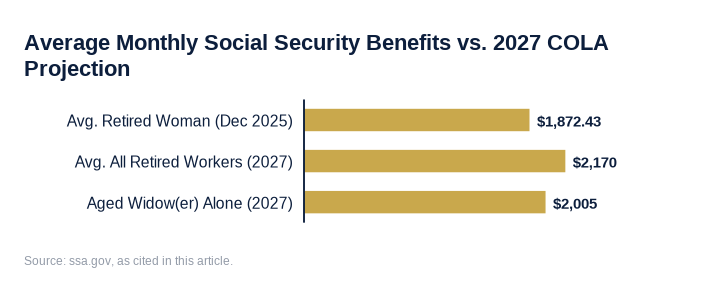
Average Monthly Social Security Benefits vs. 2027 COLA Projection
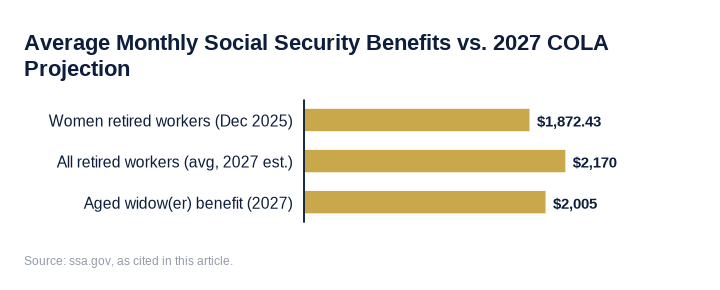
Average Monthly Social Security Benefits vs. 2027 COLA Projection
Dependence on those benefits runs deeper for women than for men. Among Social Security recipients ages 65 and older, 44% of women receive 50% or more of their income from Social Security — and 15% of women in that group depend on it for 90% or more of their income. With the aged widow(er) alone benefit rising to $2,005 per month under the 2027 COLA, the figures underscore how much of retirement income security for older women flows through a single channel that neither they nor their advisors can fully control.
Longevity stretches the stakes further. On average, women live meaningfully longer than men — a gap that compounds every financial planning decision made in retirement. A longer retirement means more years of spending, more exposure to healthcare cost inflation, and more years during which decisions made at 62 or 65 continue to ripple forward. For a woman who reaches 65 in good health, Social Security Administration actuarial tables suggest she can reasonably expect to live well into her mid-to-late 80s — meaning a plan may need to sustain income across two to three decades. That duration is why the claiming decision deserves more than a quick calculation.
Claiming Age and the Decisions It Sets in Motion
The 2027 COLA applies to whatever benefit amount a woman has already locked in through her claiming choice — and it also accrues during the period before claiming. For workers who have not yet claimed, Social Security records a notional benefit that grows with each year of additional earnings and delayed retirement credits; COLAs applied during those pre-claiming years are reflected in the eventual benefit amount when claiming begins. Once claimed, the COLA applies each year to the locked-in benefit. That makes the claiming decision one of the most consequential a pre-retiree will make, and one of the most permanent. Claiming at 62, the earliest eligible age, permanently reduces benefits relative to what full retirement age (FRA) would provide. Delaying past FRA, up to age 70, earns delayed retirement credits of 8% per year. For a woman with average or above-average longevity expectations, each year of delay can meaningfully increase the base to which every future COLA applies.
Survivor benefits add another dimension that affects women disproportionately. A surviving spouse may be entitled to receive the higher-earning spouse's benefit, but the amount available depends on both spouses' claiming histories, the survivor's own age at the time she claims survivor benefits, and applicable SSA rules. If a higher-earning spouse claimed early at a reduced amount, that reduced figure generally serves as the starting point for calculating the survivor benefit — a consequence that can reduce a widow's income for the rest of her life. If the survivor has not yet claimed her own retirement benefit, her age at the time she switches to survivor benefits will also affect the final amount she receives. Coordinating claiming ages between spouses, with an eye toward the surviving spouse's long-term income, is one of the clearest places where Social Security planning and longevity planning intersect.
Taxes, IRMAA, and What the COLA Actually Delivers Net
A higher Social Security check does not always translate directly into more spendable income. Two mechanisms can reduce the net value of a COLA increase: federal income taxation of benefits and Medicare IRMAA surcharges — and it matters to understand that these two work on different timelines.
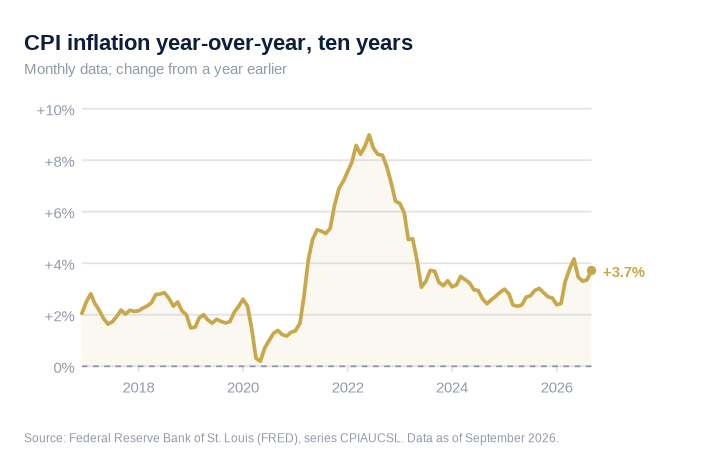
COLA adjustments are tied to consumer price inflation, which may not fully capture the healthcare-heavy costs retirees actually face.
On the tax side, Social Security benefits may be partially included in taxable income depending on a measure called provisional income — adjusted gross income, plus tax-exempt interest, plus half of Social Security benefits. It's worth being precise about how this works: the thresholds determine what percentage of your Social Security benefits are included in taxable income, not the tax rate applied to them. Up to 85% of Social Security benefits can be included in taxable income once provisional income crosses the upper threshold — $34,000 for single filers, $44,000 for married filers. Those thresholds have not been indexed for inflation since they were set in 1993, which means more retirees cross them every year. When a COLA raises benefit amounts, it can push provisional income higher, pulling more of those benefits into the taxable column — and partially offsetting the nominal gain from the adjustment in the same tax year.
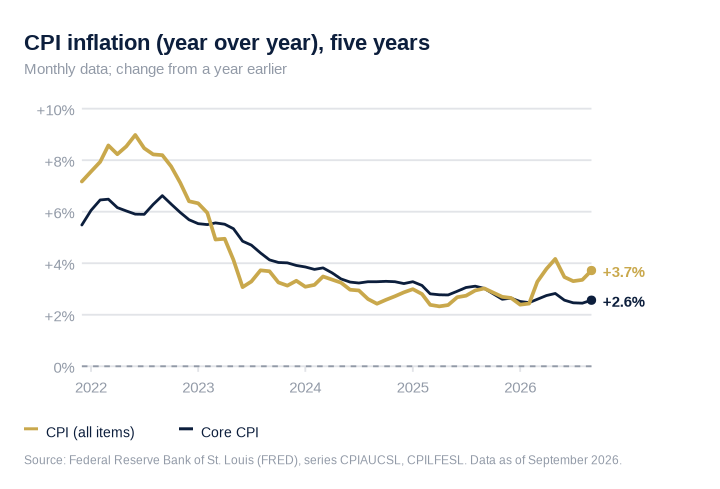
Consumer price inflation drives COLA calculations, but the index used reflects working-age spending patterns rather than retiree budgets.
Medicare IRMAA — the Income-Related Monthly Adjustment Amount — operates on a different and distinct timeline. IRMAA surcharges on Part B and Part D premiums are determined by income from two years prior, not the current year. A 2027 IRMAA assessment is based on 2025 income. For a retiree who had an unusually high-income year in 2025 — perhaps from a Roth conversion, a required minimum distribution, or a one-time capital gain — that prior-year income can trigger elevated Medicare premiums in 2027 even if current income is much lower. Looking forward, the COLA increase that raises Social Security income today may in turn affect IRMAA assessments two years later, depending on where total income lands relative to bracket thresholds. These are two separate mechanisms — higher current-year taxes on benefits and potentially higher future Medicare premiums — worth tracking on their own terms. Medicare does provide a process to appeal IRMAA determinations based on a life-changing event, which can be worth exploring if circumstances have changed significantly.
For women who are widowed, the tax picture can shift abruptly. A surviving spouse transitions from married filing jointly to single-filer status, often as soon as the year following a spouse's death. The thresholds at which Social Security becomes taxable are lower for single filers, and IRMAA brackets compress. Combined income that was unremarkable on a joint return can produce meaningful additional tax on a single return — with no change in actual income. That transition warrants its own planning conversation, ideally before it happens.
Withdrawal Sequencing and the Full Income Picture
The 3.6% COLA is calculated from the CPI-W, an index built on the spending patterns of working-age wage earners — not retirees, whose budgets carry a heavier weight toward healthcare and housing. That structural mismatch means the real purchasing power a COLA delivers over time may fall short of what the announced percentage implies. It's a reasonable prompt to review the broader income plan, not just to note the new benefit amount.
Withdrawal sequencing — which accounts you draw from and in what order — is where much of the coordination between Social Security and the rest of a retirement portfolio happens in practice. Drawing heavily from tax-deferred accounts in the early years of retirement reduces those account balances over time, which affects the tax character of remaining portfolio income and can shape how much is available in later years when other income sources, including Social Security and any pension, are already in payment. The goal of sequencing is to manage taxable income year by year — keeping bracket exposure in check while preserving flexibility across taxable, tax-deferred, and Roth accounts — so that the household retains as much of each year's income as possible, including any COLA increase. A portfolio structured without reference to expected Social Security income, tax brackets in each year of retirement, and RMD timing can produce a tax bill that offsets what a COLA was meant to deliver.
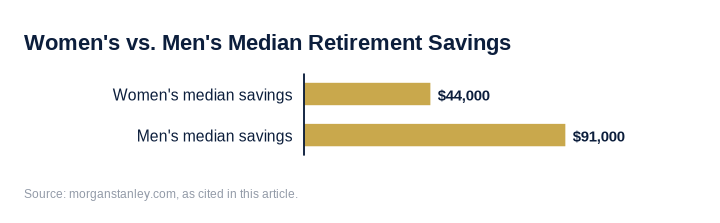
Women enter retirement with less saved on average than men, leaving Social Security to carry a heavier share of their income needs.
Women with pensions — from public-sector employment, a spouse's plan, or both — face an additional coordination layer. Pension income, Social Security, and RMDs from deferred accounts together shape the full tax picture in ways that rarely reveal themselves when each is planned in isolation. The question isn't whether the COLA is helpful; it is. The question is whether the income structure around it is designed to let the household keep as much of that increase as possible.
What it doesn't do is reorganize how that number fits with everything else — which accounts you pull from, when you pull from them, and what the cumulative tax cost looks like across a retirement that may run 25 years or longer.
Why Coordinated Planning Makes the Difference
The October COLA announcement is a reasonable prompt to revisit a retirement income plan — not just to note the new benefit amount, but to examine whether the architecture around Social Security is working as well as it could.

Longevity means retirement planning decisions made early continue to shape financial outcomes for decades.
For women approaching or already in retirement, the specific questions worth examining include: At what age does delaying Social Security produce the most durable lifetime income, given longevity expectations and other income sources? How will portfolio withdrawals be sequenced across taxable, tax-deferred, and Roth accounts to manage bracket exposure year by year? What does the transition to single-filer status do to the tax picture if a surviving spouse scenario is realistic? And does current income fall within two years of an IRMAA threshold that could affect future Medicare premiums?
These questions don't have universal answers. A high-earning professional with deferred compensation vesting in the first years of retirement faces a different bracket management challenge than a pre-retiree with a government pension that starts immediately. A woman who left the workforce for a decade to care for aging parents carries a different Social Security claiming calculus than one with a full 35-year earnings record. The answers emerge from the interaction among all the pieces, not from any one piece evaluated on its own.
At Applied Wealth Management, we work through this kind of coordination in what we call a Retirement Clarity Call — a focused conversation where we look at Social Security claiming, withdrawal sequencing, tax exposure, and survivor planning together as a connected system. If you're a woman in your 50s or 60s and want to think through how the 2027 COLA fits into your broader income picture, we'd welcome that conversation.
Common questions
What is the Social Security COLA for 2027, and when does it take effect?
The Social Security Administration announced a 3.6% cost-of-living adjustment for 2027 on October 14, 2026. Benefits increase beginning with the December 2026 benefit, payable in January 2027. For the average retired worker, the adjustment adds approximately $75 per month, bringing the average all-retired-worker benefit to roughly $2,170 per month. As of December 2025, the average monthly benefit for retired women was $1,872.43, meaning the same 3.6% rate produces a smaller dollar increase from a lower starting base.
How can the 2027 COLA increase my taxes or Medicare premiums?
When a COLA raises your Social Security benefit, it increases your provisional income — the measure used to determine how much of your Social Security is included in taxable income in that same year. Once provisional income exceeds $34,000 for single filers or $44,000 for married filers, up to 85% of benefits may be included in taxable gross income (this is the share included in income, not the tax rate itself). Separately, Medicare IRMAA surcharges operate on a two-year lookback: a 2027 IRMAA assessment is based on 2025 income. This means the COLA increase you receive in 2027 is a current-year tax question; its potential effect on Medicare premiums would not appear until 2029, depending on where your total income lands relative to IRMAA thresholds.
Why does Social Security claiming age matter more for women than for men?
Women face a longer average retirement than men — a gap confirmed by SSA actuarial data for people who reach retirement age — meaning a benefit claimed early at a reduced amount must sustain income across more years. Claiming at 62 permanently reduces the base to which every future COLA applies, while delaying to 70 earns 8% in delayed retirement credits per year and builds a larger foundation for each subsequent adjustment. For married women, the survivor benefit available after a spouse's death depends on both spouses' claiming histories, the survivor's own age at the time she claims, and applicable SSA rules. These interactions carry lasting income consequences for a population where 44% of women ages 65 and older already rely on Social Security for at least half their income.
Sources
SSA announced 3.6% COLA for 2027; average all-retired-worker benefit rises to approximately $2,170
SSA confirmed 3.6% COLA effective for December 2026 benefits payable in January 2027
44% of women ages 65+ receive 50% or more of income from Social Security; 15% depend on it for 90%+
Average life expectancy for women is 81.1 years vs. 75.8 years for men as of 2025
Women ages 70–79 face a poverty rate of 17%; for women 80+ it rises to 22%
SSA's 2027 COLA of 3.6% is the largest since 2023, adding an average $75/month
IRS: up to 85% of Social Security benefits taxable based on provisional income thresholds